Generative Recommendation as a Service: A Real Business, or Just a Good Demo?
Bhavtosh Rath
Author
TL;DR
- Small retailers get worse personalization because good recommendation has always required scale — lots of interaction data, an ML team, and infrastructure most of them don't have.
- Generative recommenders are interesting here for a specific reason: they're reported to handle cold-start and sparse-data settings better than classic collaborative filtering, which is exactly the retailer's problem.
- The stronger pitch is one shared model powering search, PDP, homepage, and cart, sold as a single API a small team can integrate in a day.
- The moat, if there is one, comes from a foundation model trained across many retailers' catalogs, where patterns learned from one customer make the next customer's cold start easier.
- The biggest open question: does the cold-start advantage survive at the data scale a small, few-hundred-SKU shop actually has, or does it only show up in papers written by companies with hundreds of millions of interactions?
A few months ago I was looking at a random online store — a small outdoor gear shop, maybe 400 SKUs, a few hundred orders a month. SKU is retail shorthand for stock-keeping unit, basically one distinct product listing; a shoe in one size and color counts as its own SKU. The "you may also like" section on the product pages looked like someone had hand-picked it during last year's holiday season, and half the items were out of stock. It's the default state of personalization for the overwhelming majority of online retailers, who will never have the traffic to make collaborative filtering work or the headcount to build something better.
That gap is what makes generative recommendation as a service worth taking seriously as something you could actually build a company around. The pitch is simple: rent state-of-the-art personalization to retailers who could never build it themselves. The real question is whether generative recommenders specifically, as opposed to any of the existing vendors already selling recommendation-as-a-service, are what makes that pitch work.
Why generative recommenders, specifically
Traditional recommenders are data-hungry in a way that punishes small retailers twice. You need enough user-item interactions to learn embeddings, and a 400-SKU store with a few hundred monthly orders spends most of its life in the cold-start zone — new items with no history, thin signal everywhere. Generative recommenders represent items as token sequences derived from content rather than an arbitrary ID learned purely from interactions, and they're reported to need far less interaction history to produce something useful — a new product's tokens come straight from its description and image. If that holds up outside the labs publishing it, it's the single most relevant property for this market, because sparse data is the whole business for a small retailer, not an edge case.
The second thing that's interesting is architectural: one generative model can plausibly serve search, item-to-item recommendations, homepage personalization, and cart suggestions, instead of four separate systems. For a retailer with no ML team, one thing to integrate that does everything is worth more than marginal lift on any single surface.
What it would actually look like
Walk through the mechanics for any small business, in the order the owner would actually experience them. They install an app from the Shopify app store, the same way they'd install any other app, and it reads their catalog automatically — product titles, images, descriptions — so there's no data file to prepare and nothing to configure by hand. The app then hands them a small snippet of code, the same kind used to add a chat widget or analytics tracker to a site, and they drop it into their store's template, the code that decides how the site's pages get built. That one paste swaps the old static "you may also like" block for recommendations that update on their own, and quietly starts feeding the site's search and homepage too. What they check afterward is a plain dashboard line: this block drove $340 in add-to-carts last week.
That's the actual bar this product has to clear: can the owner go from signing up to a live recommendation block in an afternoon, on their own, without a call with the vendor? If it needs a data scientist, theirs or the vendor's, sitting in the loop to make it work, the product has already failed the customer it's meant for.
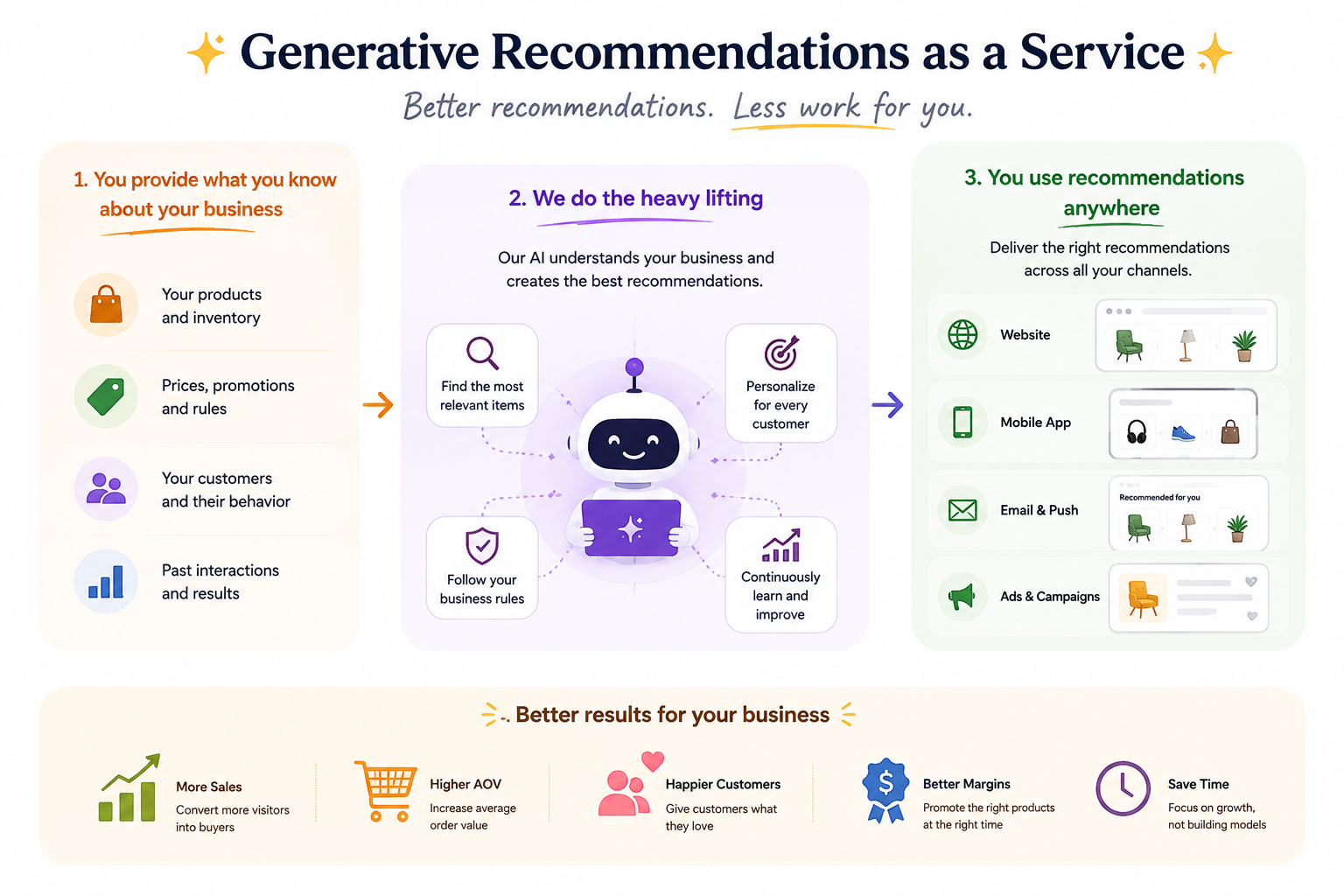 The retailer feeds in what they already have — catalog, prices, customer behavior — and the same model pushes recommendations out to every surface: site, app, email, ads.
Where this gets hard
A retailer already has three cheap options: a Shopify recommendation app for $20 a month running straightforward co-purchase rules, an existing vendor like Nosto, Klevu, or Algolia Recommend with a decade of production hardening, or nothing at all, which is what most of them are running today. Beating nothing is easy. Beating a $20-a-month rules-based app that already handles most of the value is the real competitive bar, and rules-based systems hold up better than you'd expect at this data scale — sometimes "bought together" is just correct, and a heavier model buys very little over it.
The moat question is also unresolved. A well-funded competitor can copy per-customer recommendation quality using the same open techniques. The real moat, if one exists, has to come from a foundation model trained across many retailers' catalogs and interaction logs, where cross-retailer patterns — what generally pairs with hiking boots, regardless of brand — make every new customer's cold start a little easier than the last one's. That's a genuine data network effect, but it also means the business only works if retailers are comfortable pooling their data into something shared, which is a trust problem as much as a technical one.
There's also a scale irony sitting at the center of the whole idea: the papers showing generative recommenders excel are almost all from companies with enormous interaction volumes. Whether the cold-start advantage is a property of the architecture or a byproduct of the scale those companies operate at is, as far as I can tell, still unanswered for a catalog the size of any small business's store. For this to be a real business, that advantage needs to hold at hundreds of interactions, not billions, and pricing needs to clear the bar of the $20-a-month alternative while generative inference still pencils out. Distribution basically has to run through platforms like the Shopify app store, because nobody is running outbound sales against 400-SKU stores one at a time.
If all of that holds, the product stops being a recommendation widget and starts being the thing quietly running search, merchandising, and eventually conversational shopping for stores that never hired anyone to build any of it. But I wouldn't start there. My honest bet is that this shows up first as a feature inside Shopify or BigCommerce, not as a standalone company selling directly to retailers — the distribution problem is that unforgiving. If I were actually chasing this, the first thing I'd go find out isn't the pricing model or the go-to-market plan. It's whether the cold-start advantage shows up on a real 400-SKU catalog, not a Spotify-sized one. Everything else is downstream of that one number.